 Milton's Rating Milton's Rating Rotten Tomatoes: 88%/83% (critics/audience) PG-13 July 21, 2023 1:54 hr:min ____________________________________________________________________________________________ This coming Sunday will be the 96th Academy Awards ceremony in Los Angeles and I can't let the movie season pass by without sharing a review of this remarkable film. It's rare that I would even like a picture like this and even rarer that I would give any movie five stars but I really loved Barbie for so many reasons. First, the element of surprise. Normally, I would not like a picture with a lot of silly song and dance routines, flashy colorful staging and slapstick style comedy but Barbie was actually much more profound and thoughtful than what appears on the surface. It's actually a provocative commentary on what it means to be human and the messiness of life. In the film, Barbie (played by Margot Robbie) lives in an ideal picture perfect Barbie land but wakes up one day to discover that things in her world are not quite right. She used to float but now she just falls down. By consulting with Weird Barbie she learns that a rip in the time-space continuum has occurred and that she must find the human in the real world that is messing with her doll counterpart. It's a long story but in the end Barbie chooses to leave Barbie land and enter into the real world, the world of humans thus becoming no longer "Barbie." Some of have understood the film as a protest against male domination and patriarchy or as a women's empowerment story but it's not that simple or one-sided. Granted, the men are not portrayed very well but the women even Barbie herself are not without fault. Midway through when Ken (played by Ryan Gosling) and the boys have taken over Barbie land, he blurts out to her, " [but] you failed me! Out there [in the real world] I was somebody. People respected me just for who I am." And later when the women have taken back Barbie land from the men and Ken breaks down in tears, Barbie confesses "I'm sorry I took you for granted." There are many themes in Barbie but what strikes me the most is that it's really about "what we were made for" as the beautiful theme song by Billy Eilish echoes. Stereotypical Barbie goes through this very process experiencing a breakdown in her ideal world in the process of discovering her true self. In the end, just when you think that all's well that ends well, she comes out from behind the crowd to say "I don’t really feel like Barbie anymore." Enter the creator, Ruth Handler, who brings her into an almost heavenly-like scene. She bares her heart to Ruth, "I don't really know where I belong [i.e., in Barbie land or the real world]." Finally, she asks permission to become human. Ruth says "You don't need my permission." Then comes the most profound statement in the entire film. Barbie utters:
This theme of "what we were made for" is actually a very biblical theme. Deep down inside the human heart is an innate longing for the lost world of Eden. Intuitively, we know we have a Creator and that life is the search for that meaning and purpose for which I was created. But there's one problem: the Fall (Gen. 3). This film reflects provocatively on the signs and symptoms of our fallen world. Early in the story, in the middle of an all-night dance party, Barbie says "Do you guys ever think about dying?" See Gen. 3:19. Even the ideal world of Barbie land is subject to the Fall. The real world is not much better full as it is with male patriarchy, rabid consumerism and the failed hopes of teenage feminists (cf. Sasha). But all is not lost as the script interweaves signs of hope and paradise in the real world of humanity. Barbie sees an elderly woman sitting next to her on a bus stop bench and says "You're beautiful." Barbie's transformation from the artificial world of Barbie land to being fully human in the real world is actually her redemption. For in the real world as fallen and messy as it is, it is still better to be part of a people who make meaning than the thing that is made. As I reflect on this film, I can't help thinking of Augustine's famous saying:
I could speak of many other great things about Barbie including the fine performances, the nice balance of fun and yet heart-warming scenes, innovative and creative takes on older tropes but the real 5-star clincher for me was the theme song by Billy Eilish. This song is so beautiful, fitting and meaningful. It is simply divine.
0 Comments
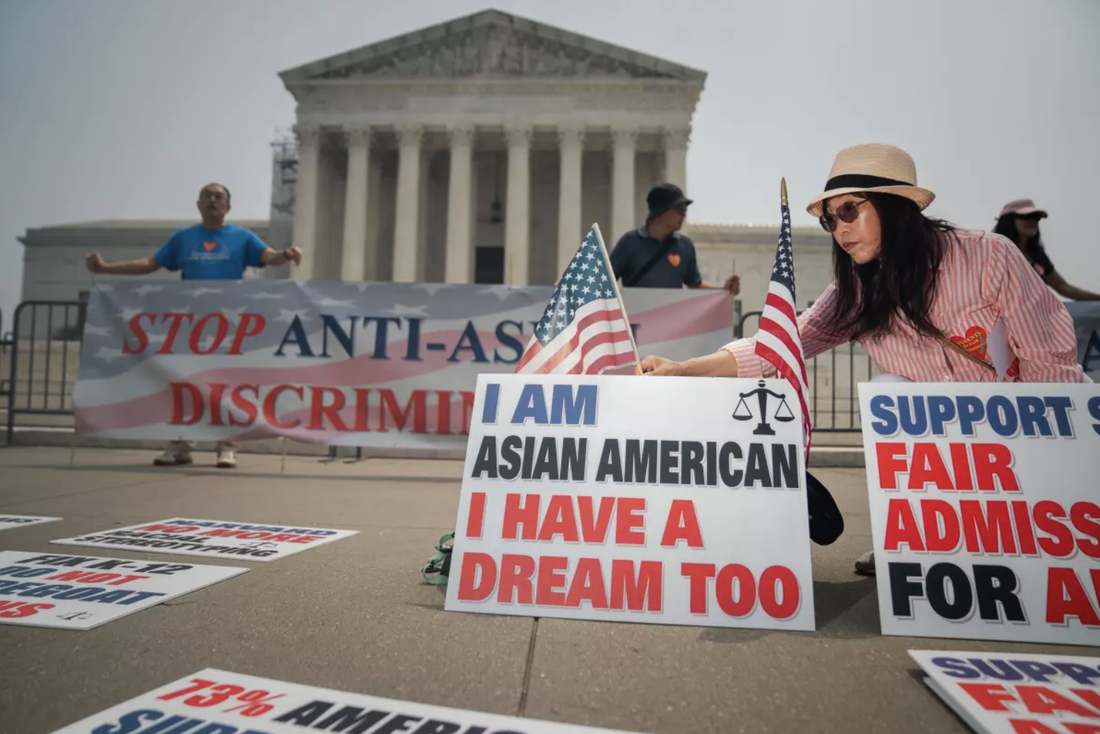 With one more week to go this month of June, the entire nation is waiting with bated breath on the Supreme Court's ruling concerning Affirmative Action in two cases against Harvard and the University of North Carolina. This ruling is probably the most consequential of the Supreme Court affecting Asian Americans in decades. SOME HISTORY Since the 1960's, Affirmative Action programs had given preferences, additional points and even set aside quotas to increase the admission of under-represented minority groups into elite colleges and universities. These groups were mainly African American, Hispanic and Native American. The two main arguments for Affirmative Action are (1) to correct the historic and systemic discrimination against these minorities in the past history of the US and (2) that Affirmative Action programs are necessary to provide a wide and diverse study body essential for the learning environment of a college in the modern world. Opponents argue that race-based admissions is discrimination based on race, pure and simple and a violation of the equal protection clause of the Fourteenth Amendment. Chief Justice John Roberts said in 2007, "The way to stop discrimination on the basis of race is to stop discriminating on the basis of race.” Over the decades, Affirmation Action has faced increasing challenges at the high court and most agree this recent challenge will be its greatest if not its total defeat. The first challenge, however, was back in 1978 with the Bakke case. I remember writing a paper on this subject in college. We called it back then the case of "reverse discrimination." An engineer named Allan Bakke had applied to the medical school at UC Davis and been rejected twice. He sued claiming that the Affirmative Action program at UC Davis discriminated against him as a white person by allowing minorities with lower test scores and qualifications in. The school had set aside 16 out of 100 seats for a separate admissions track for minorities. The court ruled that while race can be used in admissions, quotas cannot. Bakke was admitted to the medical school. Justice Lewis Powell wrote that diversity on a college campus was a "compelling state interest" and a goal which can and should be used in the admissions process but that using a quota system was going too far. But his argument in favor of Affirmative Action was based on diversity and not the social justice argument (#1 above). That became the rationale and argument in future cases. Furthermore, race should be used in conjunction with a broad set of other criteria to craft a diverse student body. In 2003, two cases involving the University of Michigan were decided by the high court. In Gratz v. Bollinger, Jennifer Gratz, a white applicant was rejected by the undergraduate school (the president at the time was Lee Bollinger). In the admissions process, the school automatically gave 20 points on a 120 point scale to African Americans, Hispanics and Native Americans. The court ruled against Michigan stating that the point system was too mechanical and against the spirit of Judge Powell's ruling in Bakke. In a second case, Grutter v. Bollinger, Barbara Grutter, a white applicant, had applied to the University of Michigan Law School and been rejected. In this case, the court sided with the school feeling that its admission process was more finely tuned and appropriate to achieve its goal. Nevertheless, writing for the majority, Justice Sandra Day O'Connor added a new wrinkle to the Affirmative Action debate:
ASIAN AMERICANS In recent years, Asian Americans have been at the forefront of efforts to undo Affirmative Action (see NY Times "Affirmative Action Battle has a New Focus: Asian-Americans"). High achieving Asian Americans argue that these programs unfairly disadvantage them. An oft-cited Princeton study is used to state that "students who identify as Asian must score 140 points higher on the SAT than whites and 450 points higher than Blacks to have the same chance of admission to private colleges" (see "This is why Asian Americans are anxious about checking boxes in college admissions"; but note a counter "Opinion: Affirmative action isn’t hurting Asian Americans"). This is often referred as the "Asian Tax." Indeed, the current cases against Harvard and UNC argue that their admissions policies discriminate not against whites but against Asian Americans. The Asian American community is divided over Affirmative Action. Many (including most of my colleagues) support it such as the group, Asian Americans Advancing Justice (AAJC). In a 2012 National Asian American Survey, three out of our Asian Americans supported Affirmative Action. "More than 160 Asian American groups filed briefs in support of UT’s affirmative-action program" (see the Atlantic's "Asian Americans and the Future of Affirmative Action"). Other Asian Americans, however, are opposed, such as the Asian American Coalition for Education (AACE). In 2015, a group of 64 Asian American organizations filed a joint complaint against Harvard and nine other universities to the Department of Education. The AACE, a coalition of 117 Asian American groups, filed a brief in support of the lawsuit of Abigail Fisher (who is white) against the University of Texas at Austin. The Supreme Court ruled in favor of the university in 2013. In the excellent and fascinating Atlantic article just cited, the author makes the brilliant observation that this divide among Asian Americans may be a generational thing. Those opposed to Affirmative Action are mostly foreign-born immigrants from China while those in favor are mostly American-born:
CONCLUSION The debate around Affirmative Action is a long and complicated one. After the killing of George Floyd in Minneapolis in 2020, no one can deny that America still has problems with race. At the same time, no one can deny either that Affirmative Action as it is currently practiced also has problems and does, I believe, discriminate against Asian Americans. A mediating and better approach is Affirmative Action based not on race but on socioeconomic factors. And here is my personal and only statement you can quote:
UPDATE: on June 29, 2023, the Supreme Court indeed struck down Affirmative Action. See NYTimes article here.
 This past July I had the great pleasure of listening to this fascinating new book This Will Not Pass by NY Times journalists Jonathan Martin and Alexander Burns on audible.com. This easy-to-read book provides the inside scoop on the politics and tumult of the latter years of the Trump presidency, the 2020 election and the first year of the Biden administration. Based on extensive interviews and access to secret tapes, the authors really do paint "gripping in-the-room" details about such critical events as Trump's handling of the coronavirus pandemic, the 2020 presidential campaigns, the January 6th attack on the Capitol building and in particular "the growing tensions between Biden and his vice president, Kamala Harris, in the White House." This is a must read for any politico. Highly recommended. I was first attracted to this book when the authors were interviewed on CNN and they mentioned that Senator Tammy Duckworth of Illinois was at first considered the top candidate as Biden's vice presidential pick. Duckworth was born of a Thai Chinese mother and American father and grew up in Hawaii. She is fluent in Thai and Indonesian and is one of the few AAPI's in the Senate. I have a particular appreciation for her because she helped sponsor the bill in 2018 in Congress to award all Chinese Americans who served in WWII the Congressional Gold Medal of which my father was one of the recipients. See the www.caww2.org website for details and my blog on this honor of a lifetime. The senator was the ideal candidate for a vice president. Growing up in poverty and living off of food stamps, Duckworth joined the army and flew helicopters in Iraq. In 2004, hers was hit by an RPG and nearly killed her but she lost two legs. In 2018, she was noted as the first senator to give birth while in office. There was only one problem: she was born in Thailand. Biden officials feared her eligibility would be attacked in a birther-style manner just as Trump had attacked Obama. Legally, such an allegation would not stand but Biden did not want to deal with the distraction such an issue might become in the middle of an intense presidential campaign. "Or so Biden told himself" as the authors end the story in the book (p. 65). And so, Tammy Duckworth was passed over for Kamala Harris. The Illinois senator appears in another interesting vignette in the book. In the early days of the now President Biden administration when he was selecting his cabinet officials …
The story continues in the book and it gets even worse. During a conference call with two of Biden's top aids, one of them,
This story and many others like it are a reminder that AAPI's for all their achievements in America remain underrepresented and under-served relative to their achievements. They remain "stuck." See Margaret Chin's Stuck: Why Asian Americans Don't Reach the Top of the Corporate Ladder (NYU Press, 2020). In a climate where "diversity and inclusion" is the mantra of the day, Asian Americans remain "invisible." Lord have mercy. *The NJ Society of Professional Journalists is holding a panel discussion this coming Thursday, October 20th at 7 pm: "Invisible Asian Americans: Are the Press and Police Ignoring New Jersey’s Fastest-Growing Minority?" at my own university William Paterson with my old friend Ti-Hua Chang as the moderator. Event is both in-person and broadcast online. Check it out on this link. I'll be there.
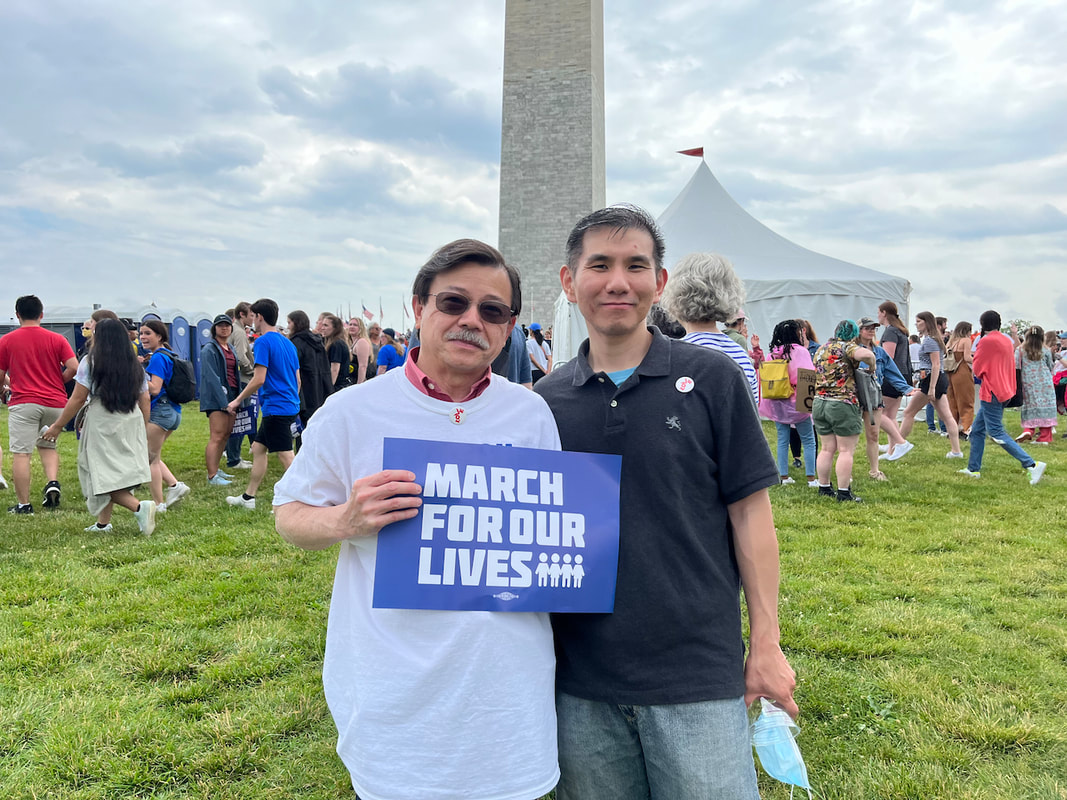 Newtown, Parkland, Buffalo, Uvalde. When is "Enough is Enough!" We have another pandemic in America. It is the pandemic of gun violence and mass shootings. I've marched locally before but this time I felt led to make the long journey to Washington, DC last Saturday for the March for Our Lives rally. Congress this very week is in the process of negotiating and passing the most significant gun safety legislation in decades. Pray that our leaders will wake up and do their job – protect the health and safety of its citizens and indeed our children. It's a four-hour drive from northern NJ and thankfully I had my church friend, Brian, to join me and make quite a day of it. The drive down went smoothly, non-stop but we got lost on foot, misinterpreting Google maps. There were probably some 5000 at the Washington monument with about a dozen speakers from Manuel Oliver (father of a Parkland victim), David Hogg (survivor of Parkland and co-founder of MFOL), the mayor of DC to Randi Weingarten (President of the AFT). One of the most interesting things at the rally were the many signs and posters (see below). At the midpoint, they asked for a moment of silence for the victims of Uvalde. As we bowed our heads in prayer, I heard a faint loud voice way up front shouting something. I looked up to see a stream of people running for their lives out to our right. Then all of a sudden people in front of Brian and I started running back toward us away from the front. I looked around and didn't see anything wondering why all the people were running. I turned myself getting ready to depart but then a stage person shouted in the mic "Stop Running!" and everyone calmed down and returned to the rally. It was quite unnerving but apparently some people thought the guy shouting said "I have a gun" and ran, creating panic and fear. Six people were injured and a Florida man was arrested. The event continued with stirring speeches from David Hogg and Randi Weingarten. A young lady named X Gonzalez (also a Parkland survivor) was among the last speakers; her speech was also rather "x-rated." The event ended but to our surprise, there was no actual "march." One may ask, what good attending such a rally will do? Well, for one thing it will raise the profile of public anger against gun violence in the country and put public pressure on our leaders to act. In a democracy, elected officials do and must listen to the people and the voters. Secondly, it also spreads and expands the movement to more people. When David Hogg spoke, he asked everyone to text "next" to 954-954 for next steps to get involved like contacting your senator. Like any not-for-profit or advocacy organization, they also requested money and it's important to give to causes you believe in even if you can't attend these rallies. For the full live video streaming, click here. While we were in DC, we decided to do some sight-seeing. I was here last year for the Chinese American WWII Recognition Ceremony and got a new appreciation of all that our nation's capital offers. We thought about visiting the Museum of the Bible and the Spy Museum but all tickets were sold out. Still, there was plenty to do and that we did. The rally ended around 2:30 pm and we tried to get into the Museum of African American History and Culture but all the tickets had been given out already. All the Smithsonian Museums and the Zoo in DC are free but timed-entry tickets are still needed for the African American museum and the Zoo. So, we visited the National Museum of American History nearby. After that, we saw the WWII Memorial, Lincoln Memorial and Vietnam Memorial. My older brother Peter actually served in Vietnam but unfortunately died of an accident after returning home from the war. Btw, you may be interested to learn that Congress and President Biden just passed into law a commission to study the possibility of creating a National Museum of Asian Pacific American History and Culture in Washington DC!
Brian wanted to visit the Jefferson Memorial but I had my doubts as it is a long way by foot across the Tidal Basin. We did it anyway (see pictures above), had a nice late dinner and headed back to Jersey. All in all, it was a long, tiring but good day in our nation's capital. We're actually planning a trip next summer to DC for the Museum of the Bible and more. Wanna join us? |
AuthorMilton's observations on life, faith and the contemporary. Archives
March 2024
Categories
|
 RSS Feed